
❖ Version History ❖
April – July, 2025
After finishing up our springtime convention cycle with the Rising Phoenix Con, it was time to start looking a lot more seriously at our publishing prospectus for Royal Threadcount. We’ve got a good prototype, we have almost exclusively positive feedback on the gameplay, and we have cornered down the player count to: 2-5 players.
Now we must take all of the information that we have gathered over the past twelve months or so and refine them down to what will be the “final” kit of the game, or at least, as close as we can get to such a thing.
Unfortunately, the birth of Iteration #4 for Royal Threadcount will effectively also be the death of the ‘dual release’ kit idea. From this point forward, the adventure into the concept of a “Indigo & Sakura Kit” ends here. As a result, we are honing back into the concept of a single game box release, with a refined set of pieces to reflect the player count. Here’s the visual scope of the components before we get into the breakdown of what’s what (and also a sneak peek at some components we haven’t talked about yet!):

Okay, so. Let’s talk about the breakdown of what we are shooting for from this point forward:
1. Player Count.
Royal Threadcount is going to officially be a 2-5 player game.
The logic for this decision comes from a few different places. First, the game is not playable solo, so it has be 2+ (obviously). Now, we had at one point considered the idea of 8 players at once when we were talking about a dual release… this is not a function idea anymore as we have honed in on the rules of the game.
We’ve specifically cut off the player count at 5 because of the “Empress’s Favorite Colors”. The Empress has a favorite color for each player in the game. Her options stem from the primary & secondary options of colors: (red, orange, yellow, green, blue, & violet). The empress most notably cannot have tertiary colors as a favorite.
With favorite coming from six total options, and bonus points being awarded for any colors that match in the end of the game, we can concluded that the game wouldn’t be fun if all six colors were active at once. This way, even with a maximum player count, there is always a bit of intrigue & mystery to how points will be awarded in the end of the game, and the strategies that will be employed along the way.
2. Component Changes:
In order to help cut down on costs for the final production, there are some components that we have reduced in the game design:
• Silk Cubes :: Once upon a time, we had enough silk cubes in the game box to cover each of the players having 7+ at once, with an extra 9 left over to cover the communal tic-tac-toe board. This was resulting in an astounding 40+ white cubes at some points (completely impractical). With some interesting tweaks introduced in the ‘player mat’ design, it has been decided that there will be exactly 14 white cubes in total: 9 to cover the communal tic-tac-toe board & an additional 1 per player for each of our five players.
• Dye Cubes :: In the very first iterations of Royal Threadcount, it was hypothesized that we would need about 9 of each color cube. Players would hold onto each color cube earned (one per turn), until they are exchanged back into the marketplace to earn a color card. The thought here is that the color cubes were always going to be spent as they were earned… but we were wrong about this. One fairly common strategy in the gameplay became hoarding your color cubes as long as you could. this meant that way more than 9 color cubes might be needed for certain moments in the game. Once again, this issue was resolved with the ‘player mat’, which gives an area to track your dye, and requires only one cube per player of each color (15 total cubes for: red, blue, & yellow).
• Sun Cube :: Ironically, one cube that was needed for the design of the game, but not in the original kit was a “sun” cube. This cube is used to track which turn it is on the communal ‘player mat’. This cube would be the same shape & size as the others, but it would be designated a unique orange color to keep it separate from the resources players use in the market.
• Ivory Card Sleeves :: As an awesome fix to a market mechanic, we were really struggling with the usage of a “pattern merchant”. The pattern merchant would always have x3 patterns to sell at any given time… but any player could pay one silk on their turn to reveal new patterns in the shop (that would stack on top of previously available patterns, thus blocking them from being purchased). Without something to make the patterns more visible, it was impossible to see what patterns were available at any given point in time. By keeping all of the patterns of the game organized in ivory colored sleeves, the patterns are much more visible, and gives the player the location to “build” their clothes (a big change from keeping the garment cards in the sleeves).
3. Final Kit Numbers:
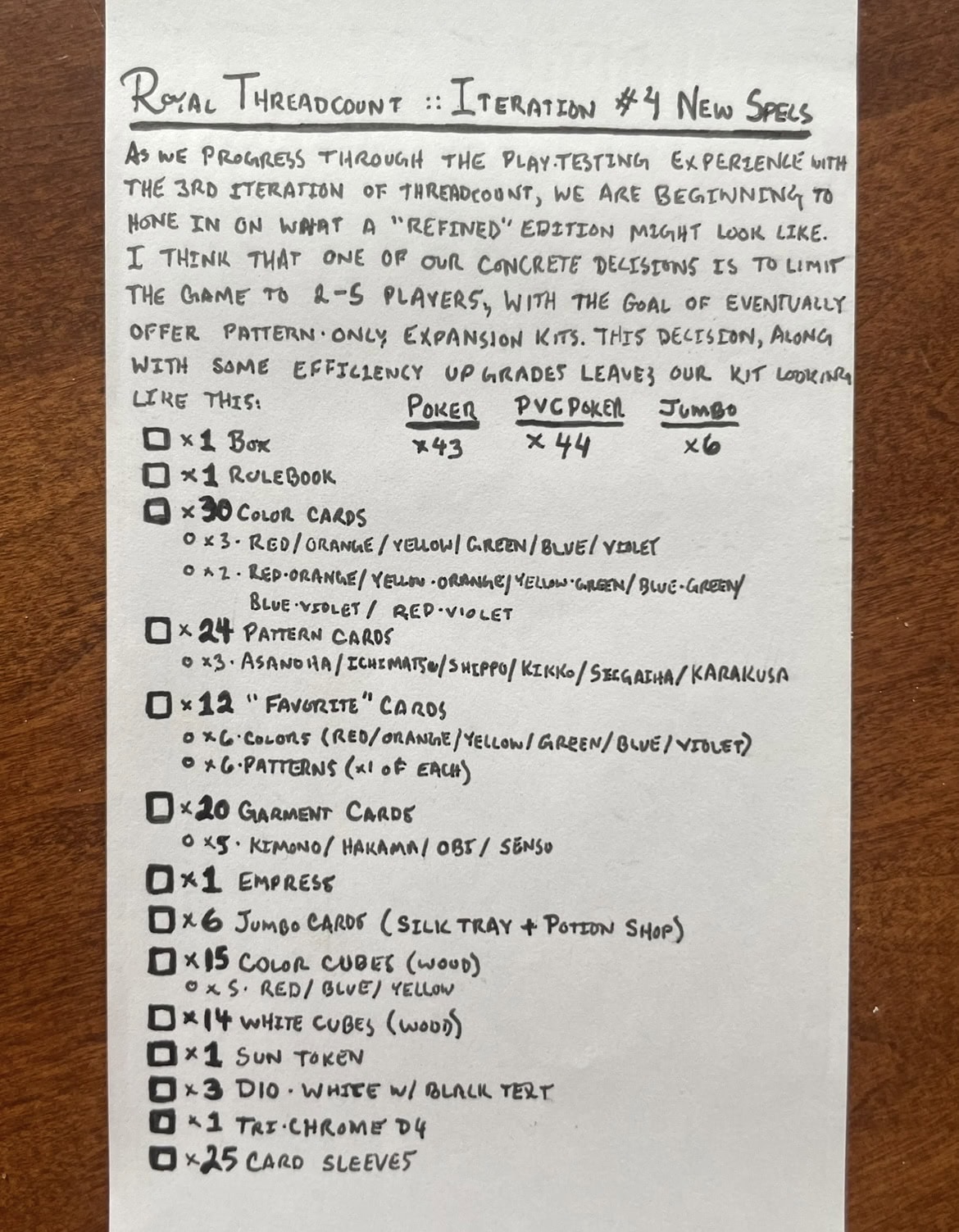
As shown in the initial image at the top of this post, the final count of all components in the game of Royal Threadcount will now look like this:
• 1-sturdy box
• 1-rules guide
• 1-trichrome d4 dice
• 3-white d10 dice
• 6-jumbo cards
• 43-cardstock cards (30 colors, 12 favorites, 1 empress)
• 44-pvc plastic cards (20 garments, 24 patterns)
• 25-ivory colored card sleeves
• 14-white wooden cubes
• 16-colored wooden cubes
This is the exact combination of ingredients that we will be passing on to our manufacturing liaison for our next and likely final quote on the total cost of the game. The good news is that we have cut down a large number of the initial component ideas… the bad news is that we added a few other… costly ingredients (like the ivory card sleeves).
After working through these options, we presented the ingredient list again to our manufacturer, and luckily got a similar quote to what we need: something under $15,000 for $1,000 units of the game. This is a very big deal when it comes to the price-point on the other side of production!
But… with all of this on the mind, and a whole new season at the CT Renaissance Faire fast approaching, it is time to get the next most important ingredient built for this game: The Rule Book. Be sure to tune back into the Librarium Games Design Journal soon for undates on that adventure!


